

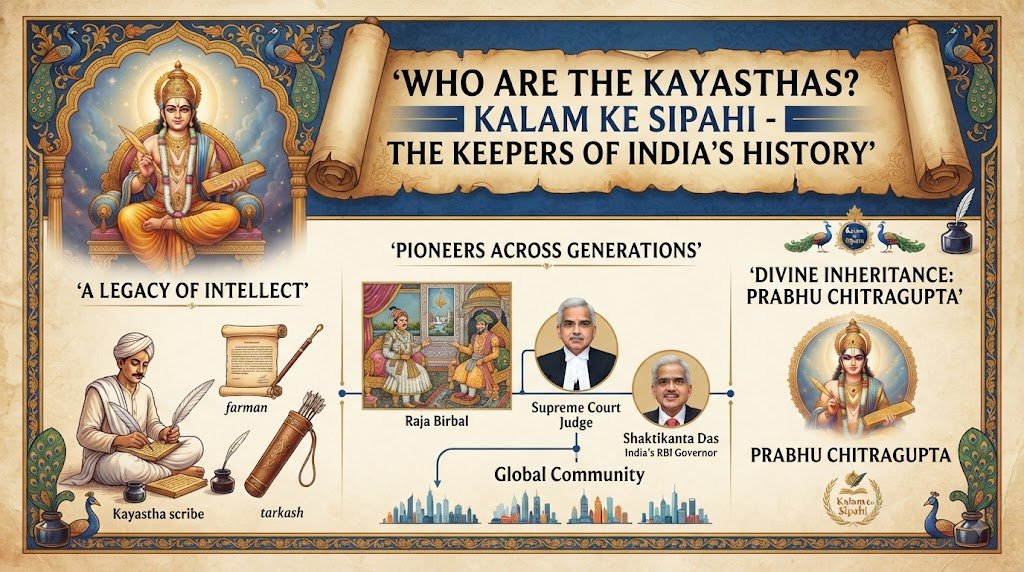
Introduction: A Legacy of Intellect and Administration
The Kayasthas stand as one of India’s oldest and most notable social groups, historically defined by their profound engagement in intellectual, managerial, governmental, and clerical professions. Over centuries of dynastic shifts and administrative evolution, they served as:
- Scribes and record-keepers
- Financial accountants and treasurers
- State ministers and diplomats
- High-ranking judges and legal advisors
- Trusted confidants to emperors and regional rulers
Renowned for their unmatched proficiency in linguistics, law, commerce, and statecraft, the community played a foundational role in running the machinery of successive Indian empires.
Roots in Antiquity
The origins of the community are chronicled extensively in ancient sacred literature. References appear prominently in foundational Hindu texts:
“The lineage and duties of the scribes and administrators are inscribed across early puranic traditions, notably the Garuda Purana, the Agni Purana, the Bhavishya Purana, and the Vayu Purana.”
Through these sacred texts and subsequent regional chronicles, the Kayasthas emerged as the preeminent bureaucrats who preserved state records, drafted edicts, and stabilized the administrative framework of ancient and medieval India.
Today, the community maintains a robust domestic presence across Uttar Pradesh, Bihar, Madhya Pradesh, Delhi, Rajasthan, Jharkhand, West Bengal, Chhattisgarh, Maharashtra, and Odisha, alongside a thriving, influential international diaspora across the globe.
Pioneers Across Generations
The intellectual DNA of the community has continuously translated into modern excellence. Kayasthas have carved out trailblazing paths across law, governance, science, literature, journalism, commerce, medicine, and the armed forces.
- Historical Luminaries: Figures such as Raja Birbal, the sharp-witted scholar and trusted advisor in the court of Emperor Akbar, epitomize the community’s historical statecraft.
- Modern Leadership: Generations of visionary freedom fighters, renowned Supreme Court justices, and political architects trace their lineage to this tradition.
- Contemporary Influence: Modern economic stewardship is powerfully represented by figures like Shaktikanta Das, India’s RBI Governor, who shapes the nation’s contemporary monetary policy.
Furthermore, modern scientific investigations—including studies by the Anthropological Survey of India—continue to illuminate the rich genetic and cultural tapestries linking the community to various neighboring ethnic groups, adding biological and historical depth to their narrative.
The Divine Architect: Prabhu Chitragupta
While the historical and secular achievements of the Kayasthas are well-documented, they point toward a deeper inquiry: Is this enduring intellectual astuteness simply the product of generations of scholarly immersion, or is it a divine inheritance?
To answer this, one must look to the spiritual genesis of the lineage: Prabhu Chitragupta, the divine scribe of Lord Yama, tasked with recording the deeds of all living beings to maintain cosmic balance and divine justice. As the ultimate ancestor and celestial architect of the community, Prabhu Chitragupta imbues the Kayastha legacy with a sacred duty—transforming the pen (kalam) into an instrument of truth, governance, and preservation.
Thus, as Kalam ke Sipahi (Soldiers of the Pen), the Kayasthas remain eternally bound to a dual heritage: one rooted in the heavenly courts of cosmic balance, and the other written across the enduring annals of Indian history.